August 9, 2026 · NeonRelic NFT Editorial
NFT Metadata Explained: Where Your Digital Art Actually Lives
Understand how NFT tokens connect to metadata and media files, how IPFS differs from regular URLs and what permanence really means for digital art.
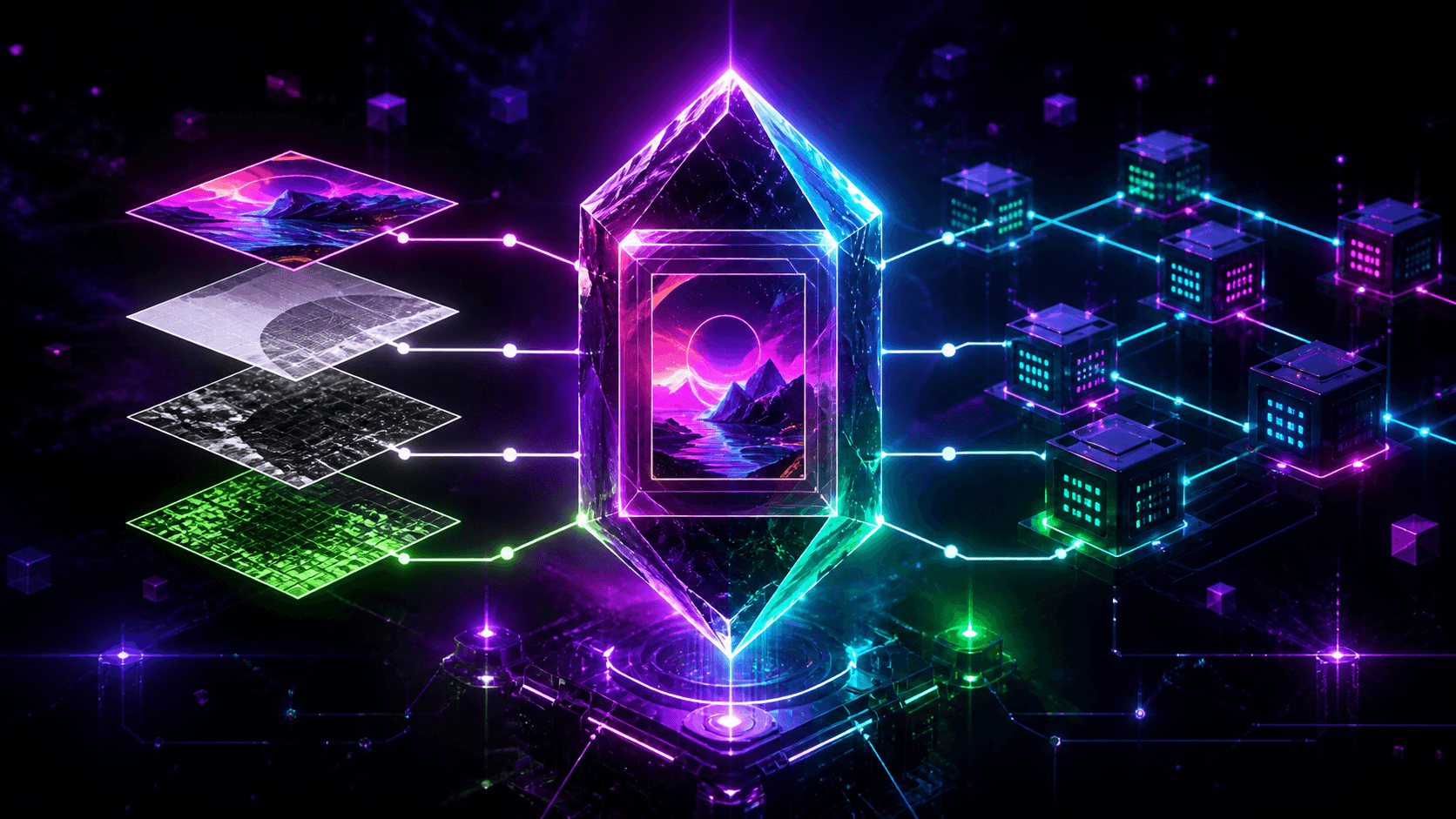
An NFT can appear as a single image in a wallet, but several technical layers work together to produce that view. The token exists in a smart contract. The contract points to metadata. The metadata describes the asset and usually points again to an image, animation, video or interactive file.
Understanding those layers helps collectors verify what they own, recognize fragile storage choices and ask better questions about permanence.
The token is not usually the image
Most NFTs do not store a full artwork inside the token itself. The blockchain records a token ID, its current owner and rules for transferring it. A function commonly called tokenURI tells applications where to find the token's metadata.
Wallets and marketplaces read that location, download the metadata and use its fields to display the name, description, attributes and media. If any link in that sequence fails, the token can still exist while the interface shows a broken image or incomplete information.
What an NFT metadata file contains
Metadata is usually a small JSON document. Common fields include:
- name: the displayed title of the token
- description: information about the work or collection
- image: a location for the primary image
- animation_url: a location for video, audio, 3D or interactive media
- attributes: traits or structured characteristics
- external_url: a project or artist page
Standards vary by blockchain and marketplace. Applications may interpret the same file differently, particularly for rich media. The important point is that metadata is a map: it tells software what the token represents and where supporting media can be found.
Conventional web URLs
A metadata or image field can use a normal HTTPS address. This is familiar and fast, but it depends on the domain, server and operator remaining available. The content at that address can potentially change without the token URI changing.
Centralized hosting is not automatically malicious. Some interactive works require servers, and active projects may need to update content. Collectors should simply understand the dependency: who controls the server, what happens if it shuts down and whether an archival version exists elsewhere.
How IPFS changes the address
The InterPlanetary File System uses content identifiers, often called CIDs. A CID is derived from the content itself. If a file changes, its identifier changes. That makes an IPFS address content-addressed rather than location-addressed.
An IPFS URI may begin with ipfs://, while a browser or marketplace may load the same content through an HTTP gateway. The gateway is a route to the content, not necessarily its permanent host.
Content addressing provides integrity, but availability still matters. At least one node must retain, or pin, the file. A CID can correctly describe a file that no accessible node is currently serving. Projects may use pinning services, their own nodes or multiple providers to improve resilience.
Arweave and permanent-storage claims
Arweave is another network used for NFT metadata and media. It is designed around long-term data storage funded through an upfront payment model. An Arweave transaction ID points to stored content and is commonly accessed through a gateway.
No storage system removes every dependency. Collectors should verify that the referenced transaction exists, that the complete media was uploaded and that the artwork does not quietly depend on additional external files.
What fully on-chain means
A fully on-chain NFT stores the data needed to produce its metadata or artwork directly in the contract or blockchain state. Some contracts return JSON and SVG data without contacting a separate storage network. Generative projects may store code and parameters on-chain and render the final output in a browser.
“On-chain” should be examined, not accepted as a slogan. A renderer might call external libraries, fonts, APIs or web services. Ask whether the work can still be reconstructed from blockchain data alone and what software is required to interpret it.
Can NFT metadata change?
It depends on the contract. Some projects keep a base URI controlled by the contract owner, allowing all token metadata to move. Others store an individual URI per token. Some freeze metadata after reveal, renounce controls or put the content directly on-chain.
Changeability can support evolving artwork and delayed reveals, but it also creates trust in whoever controls the update mechanism. Review the contract owner, upgrade permissions and project documentation. A “frozen” label on a marketplace is useful only if you understand what that marketplace checked.
How to inspect an NFT yourself
Begin with a trusted block explorer for the correct chain. Find the verified contract and token ID. Use the contract's read interface or a reputable metadata viewer to retrieve the token URI.
Then follow each layer:
- Record the contract address and token ID.
- Retrieve the token URI from the contract.
- Open the metadata and identify the media fields.
- Note whether each reference is HTTPS, IPFS, Arweave, a data URI or on-chain output.
- For IPFS, record the CID rather than only a gateway URL.
- Check whether the contract owner can change the URI.
- Download or archive permitted media and documentation for your records.
- Test interactive assets in the intended environment.
Never connect a wallet merely to inspect public metadata. Reading token information should not require a signature.
Metadata is separate from ownership rights
Technical permanence does not define legal rights. A token can point permanently to an image while copyright remains entirely with the artist. Conversely, a project can grant broad commercial rights while hosting media on a changeable server.
Read the license separately from the metadata. Ownership, access, display rights and copyright are related questions, but they are not the same question.
A practical permanence checklist
Before treating an NFT as durable, ask:
- Is the contract address authentic?
- Where does the token URI point?
- Where are the metadata and primary media stored?
- Are IPFS files actively pinned by more than one provider?
- Does the artwork require external APIs, fonts or libraries?
- Can the owner or an upgrade key change the references?
- Is the full-resolution or source media available?
- Are license terms documented separately?
- Could an independent viewer reconstruct the work?
The most useful question is not simply “is it on the blockchain?” It is “which parts are on-chain, which parts live elsewhere and who controls every dependency?” Once those layers are visible, NFT permanence becomes something you can inspect rather than assume.